
How Employee Benefits Programs with Arts and Sports Access Work


Most employee benefits programs look the same: health insurance, a 401(k), maybe a gym reimbursement that gets used twice in January. But a growing number of HR leaders are adding a different category to the mix, one built around access to arts, theater, cultural institutions, and live sports.
And the data on why makes immediate sense. More than 83% of workers report losing sleep over work stress, according to Wellhub's State of Work-Life Wellness report. Nearly half identify work stress as the primary cause of their deteriorating mental health. Traditional wellness benefits were designed to treat the symptoms. Experiential benefits are designed to address the cause.
This guide breaks down exactly how employee benefits programs with arts and sports access work, how HR teams and employees use them through dedicated apps, and why this category is proving particularly effective at reducing stress for teams in high-pressure markets like New York City.
What Are Employee Benefits Programs with Arts and Sports Access?
Employee benefits programs with access to arts and sports give companies a structured way to fund, manage, and distribute cultural and experiential benefits to their workforce. That includes museum memberships, Broadway tickets, gallery passes, professional sports access, live music, and local cultural programming, bundled into a single benefit administered at the company level.
What separates this category from older perks programs is how the access is delivered. Rather than a generic discount portal, modern experiential benefits platforms curate experiences by city, surface options that match individual employee interests, and make booking feel as simple as ordering dinner. The result is a utilization rate that passive perks models rarely achieve.
Learn how ANI curates experiential access for HR teams.
How do employee benefits programs with arts and sports access work in the US?
Employee benefits programs with arts and sports access work by giving companies a platform to allocate, manage, and distribute cultural and experiential benefits to their workforce. Employers set a per-employee budget or purchase access to a curated network of venues and experiences, employees browse and claim what they want through a centralized portal or app, and HR administrators track utilization and engagement from a single dashboard.
Most programs in the US operate through one of three models.
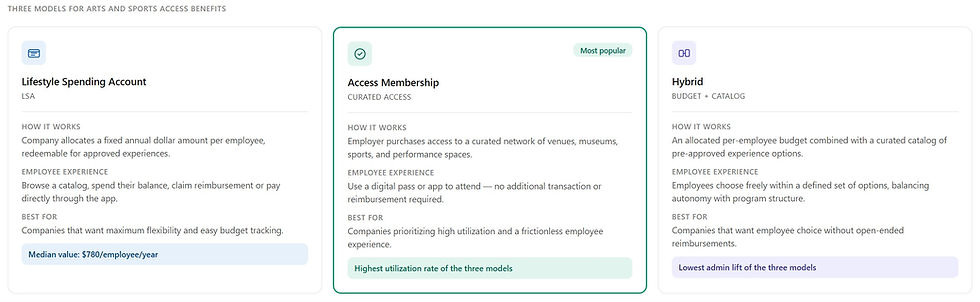
The first is a Lifestyle Spending Account (LSA), in which the company allocates a fixed dollar amount per employee, redeemable for pre-approved categories such as arts, sports, wellness, and culture. LSAs have become the most popular structured perk among modern benefits platforms, with 66% of companies now offering them at a median annual value of $780 per employee, according to Benepass. 38% of companies plan to add or expand an LSA offering in 2026.
The second model is a curated-access membership, where the employer purchases access to a network of cultural institutions and event venues. Employees use a digital pass or mobile app to attend, often without any additional transaction at the point of entry. This model removes the reimbursement friction entirely and tends to drive higher participation.
The third is a hybrid model combining an allocated budget with a curated catalog. Employees have flexibility to choose from a defined set of options, keeping the administrative burden on HR low while giving employees meaningful autonomy over how they use the benefit.
What makes arts and sports access particularly well-suited to the benefits context is the social dimension. Experiences are inherently shareable. When an employee invites a colleague to a museum opening or a team books group tickets to a game, the benefit creates genuine connection across the organization. That social layer is something a reimbursement check or gym subsidy cannot replicate.
How to use an app for employee cultural benefits in the US?
To use an app for employee cultural benefits, employees download the platform's mobile app or access a web portal, log in with their company credentials, and browse available experiences in their area. They select an event or venue, claim access using their allocated benefit funds or digital pass, and attend, often with the option to invite colleagues, friends, or family, depending on the program's terms.

Here is a step-by-step overview of how the experience works in practice, from both the employee and HR perspective.
For employees
Step 1: Download the app or access the portal. Most cultural benefits platforms are mobile-first. Employees log in with a work email or a company-provided credential. Setup takes less than two minutes.
Step 2: Build your profile. Employees select interest categories, such as arts, theater, sports, wellness, music, and so on, so the platform can surface experiences they will actually want to attend, not a generic list of everything available in the city.
Step 3: Browse curated experiences. The app surfaces upcoming events, museum access windows, sports tickets, gallery openings, and cultural programming relevant to the employee's location and interests. Good platforms update this catalog continuously rather than relying on a static list.
Step 4: Claim or book access. Employees use their allocated benefit budget, a digital pass, or a direct booking flow to secure their spot. The best platforms make this a single tap; no reimbursement forms, no receipt uploads.
Step 5: Attend, and bring people. Many platforms include social features that let employees invite colleagues, suggest group outings, or share photos from experiences. This is the element that transforms a personal perk into a team culture tool.
For HR administrators
HR leaders access a separate admin dashboard to set benefit budgets, manage employee enrollment, track utilization in real time, and pull reports on engagement and redemption rates. Platforms worth investing in make this visibility automatic; no manual reconciliation, no spreadsheet exports needed.
For a broader view of how US employers are structuring benefits in 2026, see the SHRM Employee Benefits Survey.
Platforms like ANI are designed with both experiences in mind: employees who want frictionless access to great cultural programming and HR leaders who need clean data to justify and renew the benefit each year. See how ANI works for HR teams.
How do cultural benefits reduce stress for employees in New York?

Cultural benefits reduce stress for employees by providing regular access to experiences that support mental recovery, social connection, and a meaningful sense of life outside of work. In New York, where workplace pressure is among the highest in the country, structured access to arts, sports, and cultural programming gives employees a concrete recovery mechanism rather than leaving stress management entirely to chance.
The research supports this. Employees with positive, enriching experiences outside of work are up to 40% less likely to report high levels of stress, worry, and sadness, according to a Workhuman and Gallup study on workplace wellbeing. Separately, employees who have access to structured enrichment and wellness programs are substantially more likely to report that their mental health improved over the prior year: 59% with programs, compared to just 36% without.
New York adds a specific layer of urgency to this picture. The city has an unmatched density of arts institutions, live venues, cultural organizations, and sports experiences within reach of most employees on any given week. The challenge has never been the availability of those experiences. The challenge is practical friction: tickets feel expensive, coordination takes effort, and after a demanding day, it's easier to go home than to plan something meaningful.
A benefits program that removes that friction changes the calculation. When an employee opens an app and sees that three museum exhibitions, a theater preview, and a home game are all available through their benefits this week, at no additional cost, the decision to actually go somewhere becomes much easier.
HR leaders at NYC companies are also managing a specific retention dynamic. New York employees have a wide range of alternatives, including other employers, freelance opportunities, and the option to relocate to lower-cost markets. Benefits that feel locally relevant and genuinely useful give employees a concrete reason to stay engaged with their current team and company.
Companies with comprehensive wellness and enrichment strategies see a 2.5x return on investment from improved productivity and reduced absenteeism, according to wellness program research. Cultural benefits are one component of that broader picture, but they are a uniquely social and visible one, the kind employees actually talk about with each other.
What to Look for When Choosing a Cultural Benefits Platform
For HR leaders evaluating options in this space, the category is growing. Here are the factors that matter most.
Curation quality. The experience catalog should feel handpicked. Employees are far more likely to use a platform that surfaces experiences they genuinely want to attend, not discounted bundles assembled by an aggregator.
Utilization visibility. HR leaders need real data on who is using the benefit, how often, and which experiences are most popular. Without this, it is nearly impossible to justify the investment at renewal.
Employee flexibility. The best programs give employees real choice across categories such as the arts, sports, theater, and wellness, so the benefit works equally for someone who loves the Knicks and someone who prefers MoMA.
Social and group features. Benefits that facilitate shared experiences build team culture in ways that individual perks cannot. Look for platforms that make group bookings and colleague invitations easy.
Administrative simplicity. A benefit that creates manual work for HR will eventually get deprioritized. Enrollment, redemption, and reporting should all run automatically.
Explore how ANI handles curation, utilization reporting, and HR administration.
Frequently Asked Questions
What types of experiences do arts and sports employee benefits programs typically cover?
Most programs offer access to a mix of museums, galleries, live theater and performance, professional and minor league sporting events, wellness programming, and local cultural events. Some platforms also include travel experiences or wellness activities. The range varies by platform: some focus specifically on cultural access, while others offer a broader lifestyle catalog.
How much do arts and sports benefits programs cost per employee?
Costs vary based on the model. LSA-based programs typically run between $50 and $150 per employee per month, depending on the annual allowance. Access membership models are often structured as per-seat or company-wide licenses. For most companies, a well-utilized cultural benefits program costs less per employee than underused gym reimbursement plans, while delivering higher visible engagement.
Are cultural and arts employee benefits taxable in the US?
Tax treatment depends on the benefit structure. LSA funds used for personal enrichment are generally taxable to the employee as income. Experiences provided as group company events or outings may be treated differently. HR leaders should consult a benefits counsel or tax advisor for guidance specific to their program structure.
Can employees use arts and sports benefits with family members?
Many platforms allow employees to bring guests, including family members and friends, to experiences. This is one of the features that distinguishes experiential benefits from purely individual perks. Family-friendly benefits consistently rank among the most valued by employees across all age groups.
How do you measure the ROI of a cultural benefits program?
ROI shows up across several connected metrics: benefits utilization rates, employee engagement scores, retention rates, and absenteeism data. Companies with comprehensive enrichment and wellness strategies report a 2.5x return on investment from productivity improvements alone. HR leaders can also track program-specific metrics, including redemption rates, experience attendance, and social engagement, through their platform's admin dashboard.
Conclusion
Employee benefits programs with access to the arts and sports are not a luxury for companies with extra budget. They are a practical response to a well-documented problem: employees are burned out, traditional benefits are underused, and the gap between what HR offers and what employees actually value keeps widening.
For HR directors and CPOs at NYC companies, the opportunity is immediate. The city is full of world-class experiences that most employees never access because no one has made it easy. A well-designed cultural benefits program changes that and, in doing so, builds the kind of team culture that shows up in engagement scores, retention rates, and the quality of work people bring every day.
Ready to see what experiential access benefits look like for your team? Explore ANI at alwaysani.com.


Comments