
How to Create a Cultural Benefits Program for NYC Employees


New York City has the highest concentration of world-class cultural institutions in the country. Yet most HR leaders running companies in the five boroughs still offer the same benefits stack as a team in Omaha. That gap is one of the most overlooked retention tools HR Directors and Chief People Officers have in their kit.
A cultural benefits program is a structured set of perks that gives employees meaningful access to the arts, theater, museums, live performance, and wellness experiences that define life in a great city. With 51% of U.S. workers actively seeking or on the lookout for a new job in 2025 and replacement costs averaging 33% of annual salary (HR.com State of Employee Retention 2025 to 2026), the cost of a generic benefits stack is real and measurable.
This guide walks through how to design, fund, and launch a cultural benefits program for employees in New York, with direct answers to the questions HR leaders ask most, concrete NYC institutional partners, and the data to build a business case.
What a Cultural Benefits Program Actually Is
A cultural benefits program is any employer-funded offering that gives employees subsidized or free access to arts, cultural, and experiential activities in the city where they live and work. In New York, that typically includes Broadway tickets, museum memberships, live performances at Lincoln Center or Carnegie Hall, wellness-oriented experiences such as group fitness and meditation, and social experiences that build team connection.
It is different from a traditional wellness benefit focused on gyms and apps, as well as from a generic national perks platform. The focus is place-specific, experience-led, and designed around what makes New York, New York. That place specificity is what makes these programs especially powerful for NYC-based teams.
How to Create a Cultural Benefits Program for Employees in New York?
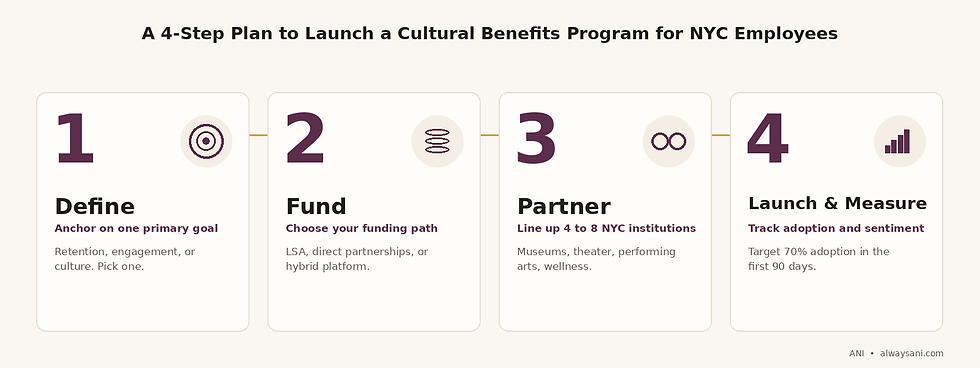
Creating a cultural benefits program for employees in New York involves four steps: defining the use cases you want to fund, choosing a funding mechanism, building partnerships with NYC institutions, and measuring adoption and impact. Most programs launch within 6 weeks and scale as participation data comes in.
Here is how to approach each step.
1. Define what the program needs to do
Start with the people problem. If retention is the primary issue, structure the program around aspirational experiences employees would rarely fund themselves. If engagement is the focus, prioritize shared experiences that bring teams together. Most NYC companies anchor on one primary goal and build eligibility rules around it.
2. Choose a funding mechanism
There are three common paths.
A lifestyle spending account (LSA) gives each employee a monthly or annual stipend to spend across approved categories such as museum memberships, theater tickets, concerts, and wellness classes. All-inclusive LSAs achieve 93% participation and 89% utilization, significantly higher than standalone wellness benefits at 70% (Mercer 2025 Health and Benefit Strategies Survey).
A direct partnership with cultural institutions provides flat-rate access for all employees, often through corporate memberships.
A hybrid program through an experiential access platform like ANI combines both, offering curated experiences and individual flexibility in one contract.
3. Build NYC-specific partnerships
Most large cultural institutions in New York have structured corporate tiers. The Museum of the City of New York, American Museum of Natural History, New York City Center, and Perelman Performing Arts Center all offer programs with employee admission, executive event access, and ticket discounts. A full program typically spans four to eight partners across museums, theater, performing arts, and wellness.
4. Launch, measure, and iterate
Track three metrics from day one: adoption rate (how many employees enroll), utilization rate (how many actively use the benefit), and sentiment lift (engagement or eNPS movement). A strong program hits at least 70% adoption inside the first 90 days.
Where Can I Find Cultural Access Benefits for Employees in New York?
HR leaders can provide cultural access benefits to employees in New York in two ways: directly through NYC cultural institutions that offer corporate membership programs, or through experiential access platforms that bundle multiple venues into a single offering. Both paths unlock employee benefits at museums, Broadway theaters, performing arts centers, and wellness partners. The choice comes down to how much administrative work you want to manage in-house.
Direct partnership options include the American Museum of Natural History, the Metropolitan Museum of Art, the Museum of the City of New York, Lincoln Center, New York City Center, Perelman Performing Arts Center, the New York Transit Museum, the Brooklyn Museum, and dozens of smaller theater, music, and dance organizations. Each has its own tiers, pricing, and benefits structure.
Experiential access platforms like ANI consolidate access across arts, theater, sports, and wellness partners, giving HR teams one contract, one invoice, and one dashboard for everything employees use. This is often the fastest path for companies between 50 and 1,000 employees who want breadth without negotiating individually with every venue. For a deeper look at the platform category, see the AMNH corporate engagement program as a representative direct-partnership example.
What Wellness Experiences Can I Offer My Team in New York Through Cultural Benefits?

Wellness experiences offered through a cultural benefits program in New York typically include live arts events, group fitness and movement classes, meditation and mindfulness sessions, museum visits (which have been shown to reduce cortisol and lift mood), and social experiences that reduce isolation. These are not traditional gym benefits; they are experience-led alternatives backed by strong evidence for mental health and team cohesion.
Research published by the NIH on cultural engagement and well-being found that participation in music, dance, and theater activities is associated with reduced symptoms of depression, anxiety, and stress in adults (NIH systematic review on cultural engagement). Arts participation also fosters social connection, a protective factor against workplace loneliness that is especially important for hybrid NYC teams.
Common experiences funded by NYC companies include:
Broadway and off-Broadway theater tickets
Meditation and breathwork at studios such as MNDFL or Inscape
Group yoga and pilates across Manhattan and Brooklyn
Museum visits to the Whitney, MoMA, Brooklyn Museum, and the Guggenheim
Live music at Carnegie Hall, Lincoln Center, and smaller venues
Sound baths, movement retreats, and wellness pop-ups
Team cooking and creative workshops
How to Improve Employee Engagement with Arts and Culture in New York Companies?
The most effective way to improve employee engagement with arts and culture in New York companies is to make participation easy, social, and regular. That means funding both individual access (so employees can pick what matters to them) and shared team experiences (so colleagues bond outside work). Engagement lifts when the benefit is visible, used often, and rooted in the local culture your employees already care about.
University of Exeter research found employees in arts and plant-enriched workspaces were roughly 15% more productive than those in lean office environments, with productivity rising to 32% when employees were empowered to design their own enriched space. Exposure to the arts, not just office decor, drives similar outcomes when employees experience cultural programming consistently.
Practical levers HR Directors at NYC companies can pull right now:
Host one team cultural experience per quarter, rotating across arts, wellness, and sports
Give each employee an individual cultural stipend through an LSA
Promote usage in the first 30 days with a launch guide, manager champions, and internal comms
Build cultural experiences into onboarding so new hires feel the culture in week one
Track engagement lift in your next eNPS or pulse survey
For more on why cultural exposure drives engagement, see our deeper piece on breaking the cycle of disengagement through arts and culture.
Frequently Asked Questions
How much does a cultural benefits program cost for a 200-person NYC company?
Budgets usually range from $20 to $200 per employee per month, depending on the scope. Most mid-market NYC companies starting out land between $50 and $100 per employee per month, which is roughly $120,000 to $240,000 annually for a 200-person team. LSAs let employers set a fixed per-employee cap, making the cost predictable.
Can cultural benefits be funded through a lifestyle spending account?
Yes. Theater tickets, museum memberships, concerts, wellness classes, and creative workshops are common eligible categories inside an LSA. Because LSA funds are employer-defined, HR teams choose exactly which experience categories to reimburse and set per-employee limits to stay on budget.
What are the best NYC cultural institutions for corporate partnerships?
The American Museum of Natural History, the Metropolitan Museum of Art, Lincoln Center, the Museum of the City of New York, the New York City Center, and the Perelman Performing Arts Center all run established corporate partnership tiers. Most offer complimentary employee admission, executive event access, ticket discounts, and event rental privileges.
How do cultural benefits differ from a traditional wellness platform?
Traditional wellness platforms focus on physical health through gyms, apps, and nutrition tracking. Cultural benefits focus on mental, emotional, and social wellness through the arts, live performance, and shared experiences. The two are complementary, not substitutes, and many NYC companies run both in parallel.
How do you measure ROI on a cultural benefits program?
Track adoption rate, utilization rate, and sentiment lift through eNPS or engagement survey deltas. Over time, tie the program to retention outcomes, especially for your top performers. With replacement costs averaging 33% of annual salary, preventing even a handful of resignations usually covers the program cost.
Conclusion
Cultural benefits are one of the few retention tools where geography is a competitive advantage. HR leaders at NYC companies sit atop a cultural ecosystem that almost no other city can match, and employees increasingly expect benefits that reflect where they actually live, not a generic national stack.
If you are an HR Director or CPO shaping your 2026 benefits strategy, a cultural benefits program should be on the short list. Start small. Launch one team cultural experience, or pilot an LSA with a defined cultural category, and scale from there based on adoption and sentiment data.
ANI is an experiential access platform built specifically to help HR teams deliver cultural, arts, sports, and wellness experiences to employees at scale. Ready to see how it would work for your team? Explore the ANI platform.


Comments