
How to Build Corporate Culture in a Hybrid Work Environment


Here is a number that should give every HR leader pause: only 2g0% of employees are engaged at work globally, according to Gallup's 2026 State of the Global Workforce report. Meanwhile, 38% of hybrid workers say they feel less connected to their company culture than they did three years ago.
Hybrid work is now the default at most organizations. The flexibility it offers employees is real and valuable. But flexibility alone does not build culture. Culture is built through connection, shared identity, and moments that make people feel like they belong to something worth showing up for.
This guide walks through practical, proven strategies HR leaders are using in 2026 to build a strong corporate culture across distributed teams, and why the companies getting it right are pulling ahead on retention, engagement, and team cohesion.
Why Hybrid Work Makes Culture Harder (and What the Data Says)
The case for hybrid work is not in dispute. Around 83% of workers prefer a mix of remote and in-office days, and companies that introduced flexible policies saw employee retention improve by as much as 41% in some cases. Hybrid employees are actually 1.7 times more likely to be fully engaged than fully in-person employees, according to recent research.
So the problem is not hybrid work itself. The problem is that most companies have not updated their culture-building to match the model they are running.
When culture was built primarily through proximity, shared physical space, and spontaneous hallway conversations, leaders could rely on osmosis. In a hybrid environment, that does not work. Culture has to be designed, not assumed.
The result of not adapting: engagement has dropped to pandemic-era lows even as hybrid adoption has increased. The companies that are thriving are the ones that have made culture-building an intentional practice rather than a byproduct of attendance.
5 Strategies for Building Corporate Culture in a Hybrid Work Environment

1. Make Connection Intentional, Not Incidental
In an office-first world, relationships are formed through proximity. In a hybrid world, you have to design the conditions for connection. This is not complicated, but it does require consistency.
Practical approaches that work:
Cross-location buddy systems that pair remote and in-office employees for weekly 15-minute check-ins
Structured onboarding experiences that give new hires meaningful touchpoints with colleagues across the organization in their first 30 days
Small-group social time built into team meetings, not as a nice-to-have but as a standing agenda item
Research on hybrid team building consistently finds that frequency matters more than intensity. A brief, regular connection between two people is more valuable for culture than an annual offsite that people attend but do not feel.
2. Build Culture Around Shared Experiences

Shared experiences are one of the most effective tools for building culture because they create memory anchors, the moments a team can look back on and say, "Remember when we did that together." Research shows that employees who feel a sense of belonging are 5x more likely to stay at their company.
The challenge in a hybrid model is ensuring those shared experiences are genuinely inclusive. An experience designed only for employees who happen to be in the office on a given day does not build shared culture; it creates an in-group and an out-group.
The most effective approach is to invest in experiences people can participate in, regardless of where and how they work. Think about: shared cultural moments like attending the same exhibition or performance virtually or in person, team challenges where everyone participates from their own location, or curated individual experiences that people then bring back to the group conversation.
This is exactly what platforms like ANI are built for: giving HR leaders a way to provide curated access to arts, sports, wellness, and entertainment experiences that employees can enjoy individually or together, with the social layer that turns those moments into shared stories. Explore how ANI works.
3. Anchor Culture in Values, Not Location
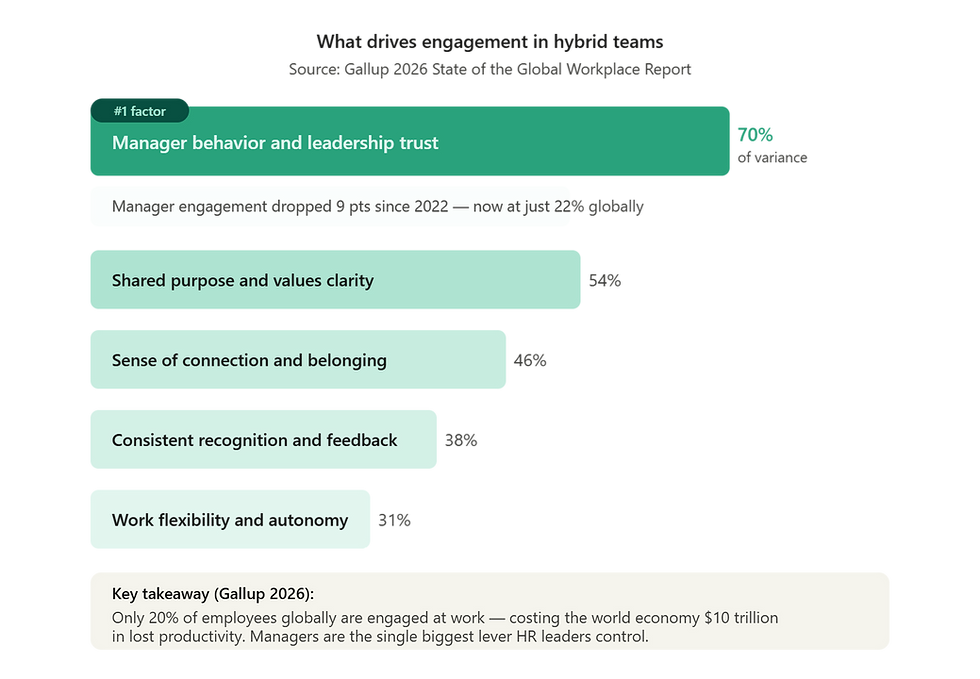
One of the most common mistakes companies make in hybrid work is conflating presence with performance and presence with culture. Managers who reward visible effort over actual output, or who build a culture around being physically together, create an environment where remote employees feel like second-class team members.
Strong hybrid culture starts with defining what the company actually values, and then reinforcing those values through behavior, not office time. This means:
Recognizing employees for impact, not hours logged
Ensuring remote employees have equal visibility in meetings and decisions
Creating leadership practices that model the values you want to see (if your values include trust, start by trusting people to work where they are most effective)
A Gallup finding worth keeping front of mind: managers account for 70% of team engagement variance. Culture flows from leadership behavior. If your managers lead with trust and consistency, your hybrid culture will reflect that.
4. Design Rituals That Work Across the Distance
Rituals are the practices that give a culture texture and identity. They are the things employees notice when they are present and miss when they are gone. In-office environments often develop rituals organically. In hybrid environments, you have to create them deliberately.
Effective hybrid rituals tend to be:
Short and repeatable (weekly or biweekly rather than quarterly)
Participatory (everyone contributes, not just leadership)
Meaningful (tied to the team's actual work or values, not just a scheduled event on the calendar)
Examples include weekly team wins shared in a Slack channel, a standing Friday team recognition thread, monthly "show and tell" sessions where someone shares something they are working on or excited about, or shared reading or viewing experiences the team discusses together.
The goal is to create touchpoints that remind people they are part of a team with a shared identity, even when they are working from different places.
5. Invest in the Experiences That Travel

Benefits and employee initiatives play a real role in culture. The problem is that most traditional benefits and People strategies are designed for a static workforce model. Health insurance, office snacks, and on-site yoga classes are not culture-building tools for a distributed team.
What does travel well across a hybrid model is access to experiences that employees can use wherever they are. A lifestyle spending account (LSA) that employees can put toward concerts, museum visits, wellness classes, or sports events gives every team member a way to participate in the experiential layer of your culture, regardless of where they are based.
Companies that invest in experiential benefits see higher benefit utilization rates and stronger employee connection to the company, because the benefit is something they actually use and talk about. When a teammate asks, "What did you do this weekend?" and the answer is, "I used my ANI benefit to catch a show," that is a culture conversation. See how ANI supports hybrid teams here.
Frequently Asked Questions
How do you build corporate culture in a hybrid work environment?
Building culture in a hybrid work environment requires intentional design rather than relying on proximity. The most effective strategies include creating regular rituals and shared experiences, anchoring culture to clearly defined values, investing in tools and benefits that are accessible to all employees regardless of location, and ensuring managers lead by example. Frequency of connection matters more than the scale of any single event.
Why is company culture harder to maintain with hybrid teams?
Hybrid work removes the spontaneous, proximity-based interactions that historically helped culture develop organically. Without those touchpoints, employees, particularly remote workers, can feel disconnected from the team and the company's identity. Research shows 38% of hybrid workers already report feeling less connected to company culture than they did three years ago.
What role do shared experiences play in hybrid culture-building?
Shared experiences create memory anchors that give teams a common vocabulary and a sense of collective identity. When employees participate in the same experiences, whether that is an event, a challenge, or a curated benefit, it creates the kind of stories and connections that hold culture together across distance. Employees with a strong sense of belonging are five times more likely to stay at their company.
What is the most common mistake HR leaders make with a hybrid culture?
The most common mistake is assuming that culture-building can continue the way it did in an office-first model. Many companies invest heavily in in-office perks and events that remote or hybrid employees cannot access, which creates division rather than cohesion. The fix is to design culture programs that are genuinely inclusive of all work arrangements from the start.
How can HR leaders measure whether their hybrid culture is working?
The most reliable indicators are employee engagement scores, retention rates, and direct feedback through pulse surveys and one-on-ones. Specific signals to watch include whether remote employees report equal access to opportunities, whether cross-team relationships are forming across location lines, and whether benefit and program utilization is consistent regardless of where employees work.
The Bottom Line
Building corporate culture in a hybrid work environment is not about fighting the model. It is about designing for it. The companies pulling ahead are the ones that have stopped waiting for presence to do the work and started creating the conditions for connection, belonging, and shared identity wherever their employees are.
That starts with intentional practices, and it is supported by the right tools and experiences. If you are looking for a way to extend your culture program to employees wherever they work, explore what ANI offers for HR teams building experiential benefits that travel.


https://soicau247.com/du-doan-xsqn.html Mình thấy bài này viết gọn, nói đúng trọng tâm nên đọc khá nhẹ nhàng, cảm ơn bạn đã đăng. Bình thường mình cũng hay xem thống kê XSMB mỗi ngày, nhưng tra cứu nhiều chỗ thì hơi tốn công nên mình tự tổng hợp lại cho dễ theo dõi. Có lần mình còn lưu lại ghi chú từ soicau247.com để lúc cần mở ra xem nhanh, khỏi phải lục lại nhiều nguồn. Nói chung ai cũng chỉ cần số liệu cập nhật theo ngày để tiện đối chiếu thì đọc kiểu này là ổn. Mình để lại đây để khi nào rảnh lại quay lại xem.